The short answer
A spiral wound gasket usually fails for one of three reasons: it was under- or over-compressed (wrong bolt load or uneven tightening), it was the wrong construction for the joint (no inner ring, wrong filler or winding metal), or the flange face was damaged or had the wrong finish. Fix those three and most leaks stop.
| Symptom | Likely cause | Prevention |
|---|---|---|
| Windings buckled inward into the bore | No inner ring; over-compression; PTFE filler | Use an inner ring (style JRIR / JCRIR); follow ASME B16.20 |
| Leak at start-up, gasket looks uncompressed | Insufficient or uneven bolt load | Controlled torque in a cross pattern, several passes |
| Leak after heating and cooling | Bolt relaxation, flange rotation, wrong filler | Graphite filler, inner ring, correct bolt stress; consider kammprofile |
| Filler burnt or powdery | Filler above its temperature limit | Graphite to ~450 °C in air, ceramic for higher; PTFE only to 260 °C |
| Pitting or cracking of windings | Wrong winding metal for the fluid | Match winding to service (316L, 321, Monel, Inconel…); check the colour code |
| Leak path across the sealing face | Radial scratches or wrong flange finish | Repair the face; 3.2–6.3 µm Ra (125–250 µin) suits spiral wound |
| Leak after maintenance | Old gasket reused | Never reuse a spiral wound gasket |
| Gasket off-centre or damaged edge | Wrong size/class or handling damage | Check size and class markings; store flat; do not hang on nails |
1. Over-compression and inward buckling
When a spiral wound gasket without an inner ring is crushed, the windings can collapse inward into the bore. Pieces of winding can then break off into the line. This is most common on large sizes, high pressure classes and PTFE-filled gaskets.
Prevention: specify an inner ring. ASME B16.20 requires inner rings for PTFE-filled gaskets and for larger sizes in the higher classes, and many refineries specify them on every gasket. See the inner ring sizes in our spiral wound dimension tables.
2. Too little or uneven bolt load
A spiral wound gasket needs enough seating stress to compress the windings to their design thickness. Hand-tightened or unevenly tightened bolts leave one side of the gasket under-compressed and it leaks on pressurisation.
Prevention: use a calibrated torque wrench or bolt tensioner, tighten in a cross (star) pattern in at least three passes (for example 30%, 60%, 100% of target), then a final check pass. Lubricate the bolts so torque turns into bolt load.
3. Thermal cycling and relaxation
Joints that heat up and cool down repeatedly, such as heat exchangers and reactor heads, lose bolt load as the bolts, flanges and gasket expand at different rates. The gasket must spring back to keep sealing.
Prevention: graphite-filled gaskets with an inner ring recover best. For exchanger joints that keep leaking, a kammprofile gasket often seals better at lower bolt load. See our heat exchanger gasket comparison.
4. The wrong filler for the temperature
The filler does the sealing. Flexible graphite oxidises in air at high temperature, and PTFE softens and creeps above 260 °C. A filler run above its limit turns to powder and the gasket starts to weep.
Prevention: graphite for most hot service up to about 450 °C in air (higher in steam or inert gas), ceramic or mica for very high temperatures, and PTFE only for chemical service at moderate temperature.
5. The wrong winding metal
SS 304 is not suitable for every fluid. Chlorides, acids and some high-temperature services attack it and the thin windings pit or crack.
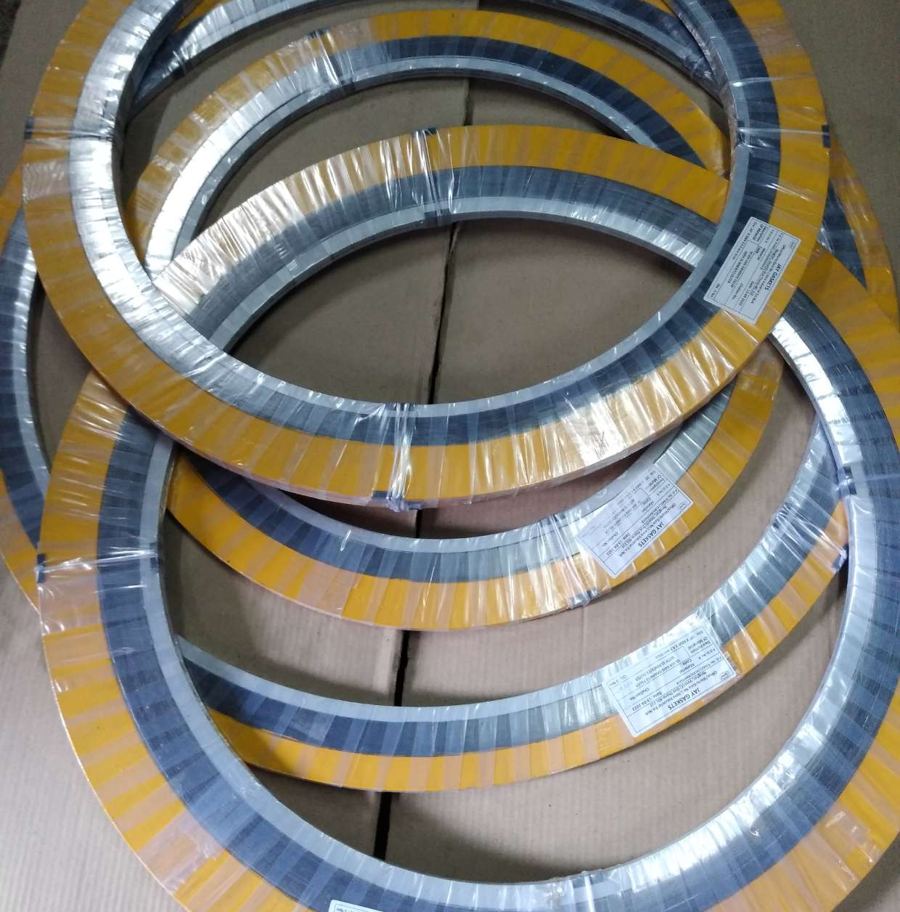
Prevention: match the winding to the fluid and flange metal: SS 316L, 321 or 347 for many process duties, Monel for seawater and HF acid, Inconel or Hastelloy for severe corrosion and heat. The ASME B16.20 colour on the outer ring lets the site team check the metal before installation; our colour code table lists them.
6. Damaged flange faces or the wrong finish
Radial scratches across the gasket seating area are direct leak paths. A face that is too smooth can also let the gasket slip and blow out.
Prevention: inspect the faces at every opening, repair radial damage, and keep a serrated finish of about 3.2–6.3 µm Ra (125–250 µin) for spiral wound gaskets.
7. Reusing the old gasket
Once compressed, the windings take a permanent set. A reused spiral wound gasket will not reseal, however carefully it is tightened.
Prevention: fit a new gasket at every opening. Keep spares of the critical sizes in stock before a shutdown.
8. Wrong size, class or handling damage
A class 150 gasket in a class 300 flange will not centre on the bolts, and a dented or bent gasket will not compress evenly.
Prevention: check the size, class, winding and filler stamped on the outer ring against the line list, store gaskets flat in their packing, and never hang them on nails or wire.